
 sales@nydcasting.com
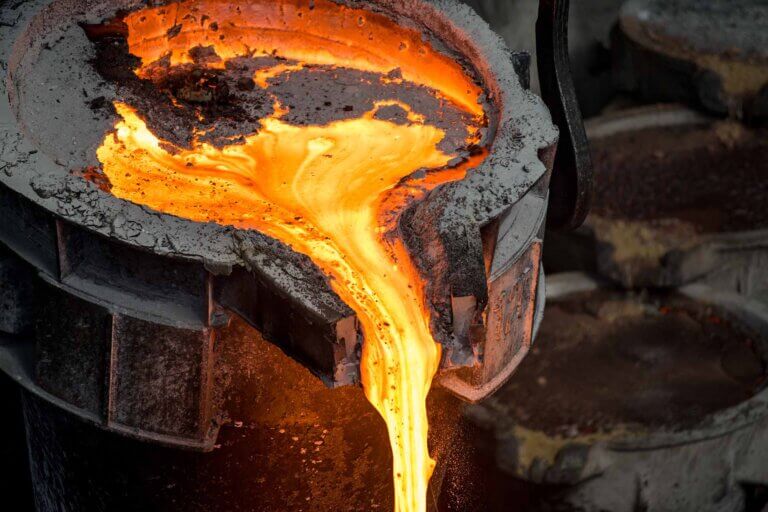
What is Ductile Iron?
Ductile cast iron is a high-strength cast iron material. It achieves a leap in mechanical properties by adding specific alloying elements (spheroidizing agents and inoculants) to ordinary gray cast iron, optimizing the morphology and distribution of internal graphite. It combines the corrosion resistance and castability of cast iron with the strength and toughness of steel.
I. Core Essence: “Spheroidization” of Graphite Morphology
The fundamental difference between ductile iron and ordinary gray cast iron lies in the spheroidal distribution of graphite within ductile iron, rather than the flake graphite found in gray cast iron. This structural difference is the core source of its performance advantages: In ordinary gray cast iron, the flake graphite acts like “micro-cracks,” fracturing the iron matrix and resulting in high brittleness and low strength. Ductile cast iron, through the addition of spheroidizing agents such as magnesium and rare earth elements, forces the graphite from “flakes” to “independent, perfectly round spheres” (industry standards require a spheroidization rate ≥85%, with high-quality products reaching over 95%). The “splitting effect” of spheroidal graphite on the iron matrix is significantly reduced, maximizing the preservation of the iron matrix’s strength and toughness.
II. Key Components and Microstructure The material properties of ductile iron are determined by its chemical composition and microstructure:
- Main Chemical Components
| Composition Category | Core Elements / Substances | Content Range | Core Function |
| Matrix Elements | | Approx. 90%–95% | Forms the basic matrix of the material and provides baseline strength. |
| Graphite-Forming Elements | Carbon (C), Silicon (Si) | C: 3.0%–4.0%; Si: 1.8%–3.2% | Carbon acts as the primary source of graphite; silicon accelerates graphite precipitation and improves castability. |
| Nodulizing Key Elements | Nodulizing agents (Magnesium (Mg), Rare Earths (Re), etc.) | Residual content: 0.03%–0.15% | Forces graphite to form spherical shapes, the critical additive for performance enhancement. |
| Performance Modifying Elements | Inoculants (Ferrosilicon, Calcium-silicon alloy, etc.) | Trace amounts | Refines graphite nodule size, promotes uniform distribution, and prevents brittle white iron structure. |
| Harmful Impurity Control | Sulfur (S), Phosphorus (P) | S ≤ 0.03%; P ≤ 0.08% | Sulfur impairs nodularization; phosphorus increases brittleness, both must be strictly limited. |
- Microstructure
The material consists of a “spheroidal graphite + metallic matrix.” The matrix type can be adjusted through heat treatment, directly determining the material’s performance characteristics:
- Ferritic matrix: Excellent toughness (elongation 15%-20%), moderate strength (tensile strength 400-500MPa), suitable for impact-resistant applications (e.g., municipal pipelines);
- Pearlitic matrix: High strength (tensile strength 600-800MPa), good wear resistance, slightly lower toughness (elongation 3%-5%), suitable for mechanical parts (e.g., gears, crankshafts);
- Ferritic-pearlitic mixed matrix: Balanced strength and toughness, the most widely used type.
III. Core Performance Characteristics: “Iron Properties, Steel Performance” The performance advantages of ductile iron are concentrated in “balance and substitution,” which can be summarized in three points:
- Excellent Mechanical Properties: Tensile strength can reach 420-1400MPa (2-3 times that of ordinary gray cast iron), elongation is up to 24%, and it can withstand deformation caused by impact, vibration, and foundation settlement, without easily becoming brittle;
- Good Corrosion Resistance and Castability: Retaining the natural resistance of cast iron to soil and water corrosion, with anti-corrosion treatment (such as coatings and linings), its underground service life can reach 50-100 years; and it can be used to manufacture complex-shaped parts (such as pipes and valves) through various processes such as sand casting and centrifugation;
- Significant Cost Advantage: Performance is close to cast steel, but the production cost is only 60%-80% of that of cast steel, making it a high-performance, cost-effective alternative to gray cast iron and cast steel.
IV. Simplified Explanation: “Upgraded Cast Iron”
Ductile cast iron can be viewed as a “technological upgrade of ordinary gray cast iron”—Ordinary gray cast iron is like “cement mixed with broken glass” (flaky graphite = broken glass, easily cracked); Ductile cast iron is like “cement mixed with rounded rubber particles” (spheroidal graphite = rounded rubber particles, retaining strength while increasing toughness).
In summary, the essence of ductile cast iron is “high-strength cast iron with optimized performance through graphite spheroidization.” Its core value lies in achieving a balance of “strength, toughness, corrosion resistance, and castability” at a relatively low cost, making it a core material in fields such as municipal engineering, machinery manufacturing, and the automotive industry.