
 sales@nydcasting.com
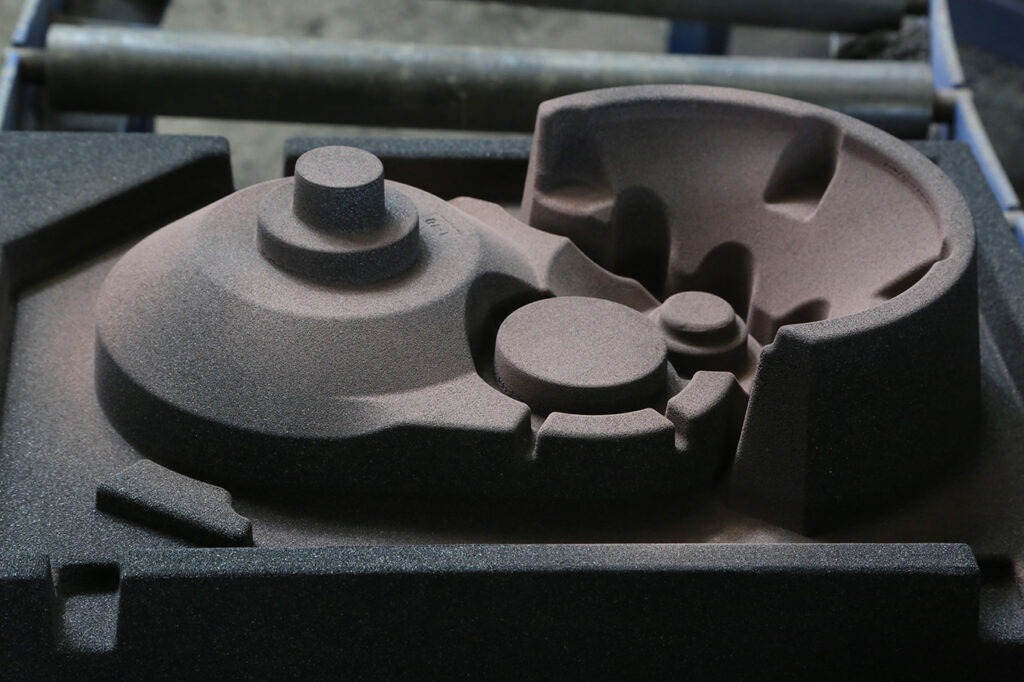
The term “sand casting” refers to both the final product and the manufacturing process itself. It is a metal casting method performed in foundries and ranks among the oldest such processes. In this technique, sand serves as the mold material. Sand casting is a widely used process that employs a mixture of sand and a binder—such as clay—to create molds. The technology is used to produce complex metal parts in a wide range of sizes and shapes. More than 60% of the metal castings we encounter in daily life are produced using the sand casting process. In this article, we will examine how sand casting works and explore the process’s advantages, disadvantages, types, applications, and more. Let’s get started!
What is sand casting?
Sand casting is a cost-effective casting method capable of producing a wide range of metal castings, from small, intricate parts to large, simple components. The relatively low cost of mold production makes this process highly attractive to many manufacturers.
Fundamentally, sand casting is an ideal method for producing various metal parts due to its simplicity and efficiency. The process begins with the creation of a sand mold designed to precisely replicate the contours of the desired product. Molten metal is then poured into the mold; once it cools and solidifies, the final product is obtained. Although the process may appear straightforward, each step involves critical factors that require careful consideration and control.
What is the working principle of sand casting?
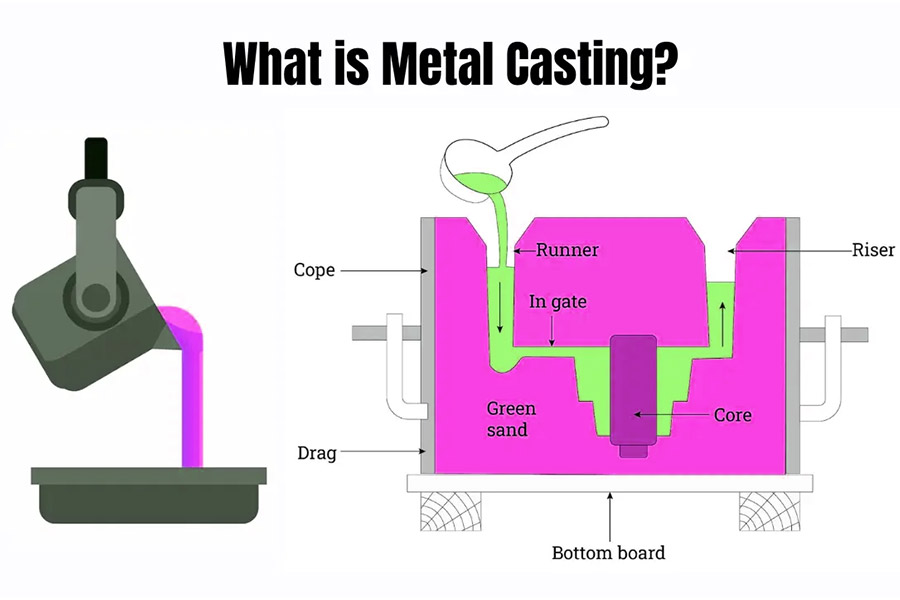
The working principle of sand casting leverages the malleability and moldability of sand to produce desired castings through steps such as pattern making, pouring, solidification, and cooling. This casting method offers low costs, short production cycles, and a wide range of applications. It is particularly suitable for producing castings of various sizes and complex shapes, especially large-scale castings. The detailed process flow for sand casting is as follows:
- Pattern Making
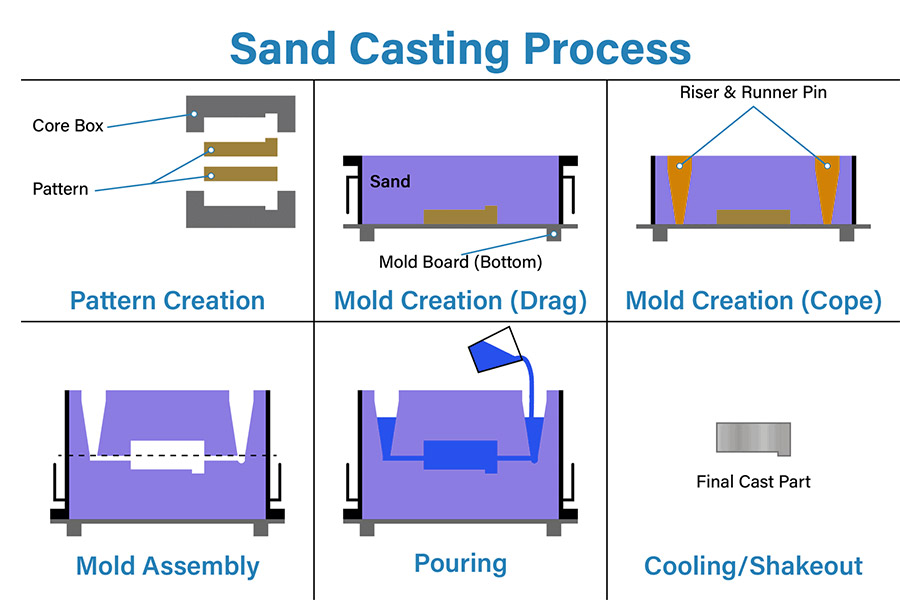
The first step in sand casting is to create a pattern based on the casting’s design specifications. Wooden patterns are typically used for single-piece production; plastic or metal patterns are chosen for batch production; and pattern plates may be used to enhance efficiency in mass production. The precision and quality of the pattern directly affect the quality of the final casting.
- Sand Preparation
Molding sand and core sand are prepared according to the casting type and mold requirements. A sand mixer is typically used to uniformly blend used sand, new sand, and clay. The properties of the molding sand significantly influence the casting’s surface quality and the likelihood of internal defects.
- Pattern Making and Molding
Pattern making involves creating the pattern and core box based on the part drawings. Molding involves packing sand around the pattern to form the mold cavity, while core making creates the internal shape of the casting. Mold assembly involves placing the prepared sand core into the cavity and closing the flask. This stage requires the sand mold to have high strength and good sealing properties to prevent molten metal leakage during pouring.
- Melting
Alloy materials are prepared and melted in a furnace to produce liquid metal that meets the required composition specifications. Strict control of the metal composition and temperature during melting is essential to ensure the casting’s performance and quality.
- Pouring
Molten metal is poured into the sand mold. This stage involves significant risk, requiring strict adherence to safety protocols. Pouring speed and temperature have a major impact on casting quality and must be carefully controlled.
- Solidification and Cooling
The molten metal cools and solidifies within the sand mold to form the casting. Metals undergo shrinkage during solidification; therefore, factors such as draft angles and wall thickness must be considered during mold design to prevent casting defects.
- Cleaning
Once the molten metal has fully solidified, the molding sand is removed, and the gating system and other auxiliary components are knocked off, resulting in the finished casting. During the cleaning process, care must be taken to preserve the surface quality of the casting and avoid scratches or impact damage.
What types of sand are used in sand casting?
Sand casting primarily utilizes the following types of sand:
- Green Sand
Green sand casting employs molds made from moist sand containing water and organic binders (such as clay). The term “green sand” refers to the fact that the mold has not yet “set,” “cured,” or “hardened” at the time the molten metal is poured into it. Because the sand can be reused, green sand casting is a simple and cost-effective process. However, a disadvantage is that the molds are relatively soft and prone to collapsing or shifting during the casting process.
- Water Glass (Sodium Silicate)
Sodium silicate can be used to create sand molds. This process is particularly advantageous for sand casting applications that require internal cavities (cores). When carbon dioxide is introduced, sodium silicate rapidly transitions from a liquid to a solid state due to dehydration. It must be mixed with other additives to ensure the core can be removed during the shakeout process; if the mixing ratio is incorrect, the core may become stuck inside the casting.
- Resin Sand
The molding material for resin sand casting is a mixture of silica sand and resin. When mixed and heated, the resin sand hardens to form a strong, smooth mold. While these robust molds reduce casting defects, the process entails higher costs and slower production speeds. Producing resin sand molds takes longer because each mold requires individual mixing and curing.
What are the advantages and disadvantages of sand casting?
The advantages and disadvantages of sand casting are as follows:
Advantages:
- High Versatility: Sand casting can produce castings of almost any shape and size, ranging from simple geometric forms to complex mechanical components.
- Low Cost: Compared to other casting methods, the costs for equipment and tooling are relatively low, and raw materials are readily available, resulting in lower overall production costs.
- Process Flexibility: The sand casting process is relatively simple and easy to adjust or improve. It also allows for modifications and adjustments during production to meet specific casting requirements. High material utilization: Through rational process design and operation, sand casting allows for the efficient use of casting materials, minimizing waste and maximizing material utilization.
- Recyclability: Although the sand mold must be discarded after each casting, the sand itself can be processed and reused, helping to reduce resource waste.
Disadvantages:
- Low production efficiency: The mold-making and pouring processes in sand casting are complex and time-consuming, requiring significant labor and resulting in relatively low production efficiency.
- Limited casting precision and surface quality: Due to the difficulty in fully controlling the compaction and uniformity of the sand mold, the dimensional accuracy and surface quality of the castings may be compromised to some extent.
- Environmental pollution: The sand casting process can generate pollutants such as dust, exhaust gases, and wastewater, causing environmental pollution. While this can be mitigated through environmental protection measures, the environmental impact remains a concern.
- High energy consumption: Sand casting requires substantial energy to heat the metal and maintain the temperature of the casting workshop, leading to increased production costs and energy usage.
- High labor intensity and safety hazards: Sand casting is a labor-intensive process requiring operators to perform heavy physical work. Additionally, the process involves safety hazards such as high temperatures, dust, and noise, necessitating effective protective measures to ensure operator safety.
What are the applications of sand casting?
As a manufacturing process with a long history, sand casting continues to play a vital role in modern manufacturing. It is widely applied across many sectors, including:
Automotive Industry
In automotive manufacturing, sand casting is a key method for producing components with complex geometries. Critical parts such as engine blocks and transmission housings are commonly manufactured using this technique.
Aerospace Industry
Sand casting is also prevalent in the aerospace industry. It is frequently used to manufacture aircraft engine components and structural parts that demand exceptional strength and precision. Specifically, turbine blades, casings, brackets, and various accessories can be precisely manufactured using sand casting technology.
Construction Applications
In the construction industry, sand casting is commonly used to produce essential products such as pipe fittings and manhole covers. The process imparts superior durability and robustness to these products, ensuring a long service life in construction applications.
Piping System Components
Sand casting offers unique advantages in the field of piping systems. It is widely used to manufacture core components—such as valve bodies, pipe joints, and couplings—that play a critical role in these systems.
Mass Production of Metal Products
Sand casting holds a significant position in global metal product manufacturing. It plays a key role in producing everything from traditional weaponry, such as swords, to everyday items like cookware. Although other manufacturing methods have emerged with technological advancements, sand casting retains an irreplaceable status due to its cost-effectiveness and suitability for mass production.